On their own, pictures can undoubtedly be meaningful. But the combined effect of certain images, if used properly, can have an infinitely more powerful effect. This particular image is iconic of Roland Barthes’s notion (portrayed in Rhetoric of the Image) of several individual parts comprising a whole. Although each picture here tells a story, the image as a whole is worth more than the sum of its parts.
It is no secret that environmental issues are a growing global concern. Barely a day goes by when some new ecological catastrophe doesn’t make the front page. With all this talk of death and destruction, is there really any hope left at all? This image attempts to take on that dichotomy and propose an answer. There is no linguistic message to this image, as words would detract from the iconic and coded-iconic messages that the images convey.
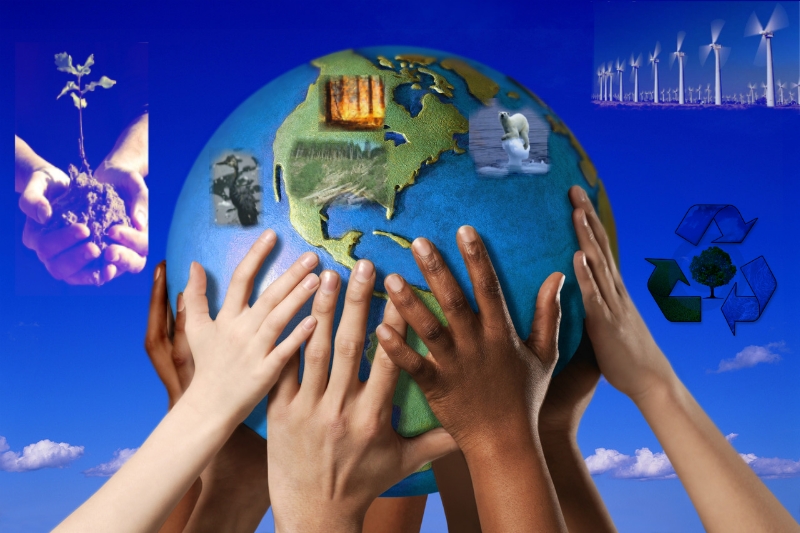
“Our Mother Earth” aims to summarize the environmental impacts humans have on their Mother Earth. As this image is a combination of multiple parts, it is best to break down what the parts mean individually, and then asses their connoted affect as a whole. By doing so, several different layers of messages are inferred.
The literal message is denoted from analyzing the individual parts as they are. The physical globe itself, and the images contained within it, represent some of the most prominent environmental issues we face today. Many of these are primarily driven by human actions. The two images on land represent forest fires and deforestation. Although not all forest fires are man-made, those that are leave unnatural and avoidable destruction in their wake. Deforestation is an environmental issue that is entirely created by man. The human race is annihilating the world’s forests at an alarming rate, and with it, the habitat of all the species that call the forest their home. In the water, two more environmental issues arise. The image of a polar bear floating on a single floe of ice has become iconic in today’s society. It literally represents the notion of the polar bears’ loss of habitat. The last image on the globe portrays a bird covered in oil, with an oil slick trailing away. This is another pictorial denotation of an entirely man-made environmental catastrophe.
Surrounding the physical globe are some more positively connoted images, portraying some of man’s innovative solutions to environmental problems. Circumnavigating the globe in a clockwise direction, we see wind turbines, a recycling symbol, and the planting of a sapling. Hands of many shapes, sizes, and colors hold the globe aloft against a background of a clear blue sky.
Out of Barthes’s linguistic, literal, and symbolic messages, the overall symbolic message is by far the most important to this image. Each picture used here has a meaning in itself, yet the amalgamation tells a story. The connotation of the images within the globe is primarily negative – we see an overall image of a burning, destructive world. We visualize disasters such as the Exxon Valdez oil spill and logging in the Amazon rain forest. We sympathize with the majestic polar bear that is quickly losing its home due to global warming. Yet surrounding the globe, we find hope. The innovative ideas of man surround a world in turmoil, and hands reach out in support and collaboration. The promise of cleaner energy is connoted by the spinning wind turbines. The young sapling represents reforestation efforts; a prominent goal within the green movement. The universal symbol for recycling is iconic of the “Reuse, Reduce, Recycle” campaign for a greener tomorrow. The image as a whole tells a symbolic story of growing environmental problems, yet also a surge in diverse collaborative innovation in order to counter them. Although images of destruction comprise the image, the overall message conveyed is one of hope, thus exemplifying Barthes’s declaration of an image representing more than the sum of its parts.
All of my images were found using a Creative Commons image search (http://creativecommons.org/). Individual URL's are as follows:
Polar bear: http://peapod-peasinapod.blogspot.com/2010/12/free-polar-bear-unit-study...
Wind turbines: http://www.crdf.org/factsheets/factsheets_show.htm?doc_id=512518
Earth: http://www.pembinatrails.ca/bairdmore/seasonal_links.htm
Recycle: http://discoveryschoolnews.wordpress.com/
Forrest fire: http://www.adpartners.org/about.html
Deforestation: http://save-environment.com/general-environment/deforestation-a-threat-t...
Sapling: http://naples-florida.olx.com/help-plant-trees-iid-7853883
Comments
The image is very colorful
The image is very colorful and visually appealing. I like your use of vocabulary and language in your analysis. I would also like to note your use of background information, in particular, your descriptions of the environmental issues that are present today, because it gives the viewer a better understanding of why you composed the image in the way that you did. The only thing that I would have liked to see more of, is specifically breaking down the image in terms of it's different meanings, instead of just what each part of the image conveys. For example, a linguistic meaning (if any), a literal meaning, and a symbolic meaning. I see that you have discussed the symbolic meaning though, and it is done very well. Overall, very good job!