They say a picture is worth a thousand words, but does that age old statement take into consideration who is speaking. Did the author mean that an image spawns discussion from thousands of perspectives or does the image tell its own story by itself? In actuality, neither answer is incorrect and it probably depends on the picture in question; some tend to be more abstract allowing for multiple interpretations while others are simple like the United States Forest Service’s lovable bear that reminds us of our responsibilities. Regardless pictures have messages that they are trying to get the reader to understand, these messages may be implied or not. According to Barthes’ Rhetoric of the Image essay, there are three messages within a picture: the linguistic message, the literal message, and the symbolic message. The attached image conveys all three of these messages.
The linguistic message is the text and words that appear on the picture. The linguistic message presents to the reader the questions: “what is going on?” and “what is it saying?” The picture I provided contains text that suggests the image as a movie poster. The words on the image hint to the upcoming free agent period this summer. It makes reference to some of the fallout from last summer’s “Decision” from NBA superstar LeBron James, suggesting that these shenanigans are likely to continues
The literal message is exactly what it sounds like. It means what the image is all about, what is it saying at its most basic level. For the image of Carmelo Anthony, the literal message is that he has a tough decision ahead of him this summer if he is not traded before this season’s trade deadline. The image also portrays a satirical and cynical message in both the language used and the suggestion of the dream bubble.
The final message that can be seen in an image is the symbolic message. This is the most arguable and loosely interpreted message. The symbolic message that the author intended to portray might not be understood by the reader, or the reader may interpret a different message than the one the author intended. The message that I am trying to portray is embedded in the satire of the image. The symbolic message here suggests that athletes have entirely too much power in their hands, and as time progresses the ridiculousness of their behavior is exacerbated. Last summer’s nationally televised primetime event entitled “The Decision” was an hour long event by LeBron James to announce to the world where he would play basketball this season. This image through the idea that the behavior of athletes suggests a level of one-upmanship is seen in its design as a movie poster. Carmelo has had to hear that he was a “poor man’s LeBron” since his time in high school, so the only way to one-up “The Decision” would be to make a movie of his life changing decision. This image also symbolizes how important sports have become in our society. Before these last few seasons there was never as much hype over the impending free agency of a superstar two years before that moment is supposed to happen. This photo echoes the notion that sports and entertainment consume more out of the average individual.
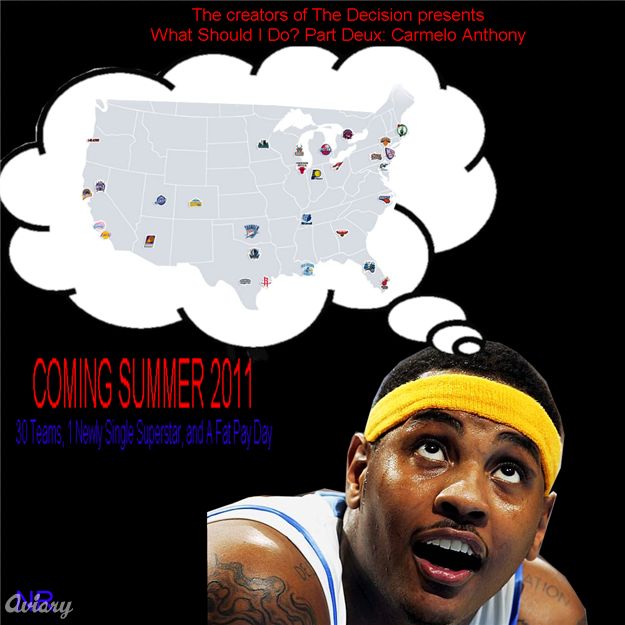
Carmelo image courtesy of layupdrill.com
Dream bubble came from a google image search
The map displaying the geography of NBA teams came from a blogsite: http://xandersamericanhistory.blogspot.com/2010_05_01_archive.html