Images are powerful because they are flexible. An image can speak across barriers of language, culture, and time. More importantly, images send complex messages. Their meaning can be multifaceted, can apply to multiple situations. Even an image crafted for a highly specific purpose can maintain its relevance long after the event it referenced is over. Guernica can still horrify, can still ignite feelings of shame over man’s inability to have empathy for his fellows. The image of the tank man, standing against oppression, has power outside of China. Roland Barthes’ essay “Rhetoric of the Image” discusses three distinct layers of meaning to an image. The linguistic, coded iconic, and non-coded iconic layers focus work together to produce the total message of an image.
In this image, Tahrir Freedom, one can see only one linguistic message. A man wears a sign around his neck which reads: “Facebook.” This has to do with the nature of what is being depicted. The man with the sign around his neck is in Cairo, protesting the abusive nature of his government. Facebook was important in spreading the message of outrage at the beating death of a young, innocent citizen. Even though only one social networking site is mentioned in the text of the image, this single word also references the power of the other networks that helped spread the word and bring the people into the streets. It is important to note that there are other linguistic messages in the image, but that they are in a language other than English, and therefore uninterpretable precisely. They are likely messages of protest against the government.
The coded iconic message of this image is much more complex than either the linguistic message or the non-coded iconic message. Coded iconic messages speak to the viewer through commonly accepted cultural tropes. One can see a map of Tunisia at the center of the image, the revolution in Tunisa helped create a groundswell of support for revolution in Egypt, and it is thus related to the rest of the image. Below this section of the image are three instantly recognizable faces, Ghandi, Mandela, and King. These men marched peacefully for change in their countries, and earned rights for their people. By juxtaposing images of these men with images of people in Egypt, the image suggests a similiarity between the two. Thus the image argues for the legitimacy of the people protesting in Egypt. The bottom left image shows an average Egyptian man with fired 12 gauge shotgun shells on his fingers. This section of the image implies that the police used shotguns in the square against the people. The bottom right shows two protesters with signs, both of them smiling. This section of the image helps the viewer relate, it makes the image more emotionally powerful. In the center of the image, one can see two young people with images of the Egyptian flag. Egypt is a young country, and by putting young people with the flag, the image says that these people, these young people are Egypt. The last part of the image with a coded iconic message is the spread across the top. This part of the image is of Tahrir square itself filled with thousands of people. It shows the number of people who are willing to put themselves in danger for change. While far from a cartoon, the effect of the image is amplified by a feature Scott McCloud describes in his book Understanding Comics. The faces of the Egyptians in the image, their clothes, their facial expressions, and even their hair, all of these are familiar to a westerner’s eye. They are not wearing turbans or grimacing. These features but especially their physical expressions make them appear familiar, as if they can be related to. This generates an emotional connection between them and the viewer. The coded iconic message of the image is that the protesters are everyday Egyptians, that their grievances are real, and that their cause is legitimate.
The non-coded iconic message of this image is simple. There is a map drawn with simple lines. There were people here. There were African men, Arab men, Indian men, and a baby. At one point, many people were in a city. The fact that the non-coded message is so simple lends power to the coded message, however. Simplicity breeds understanding, even across boundaries.
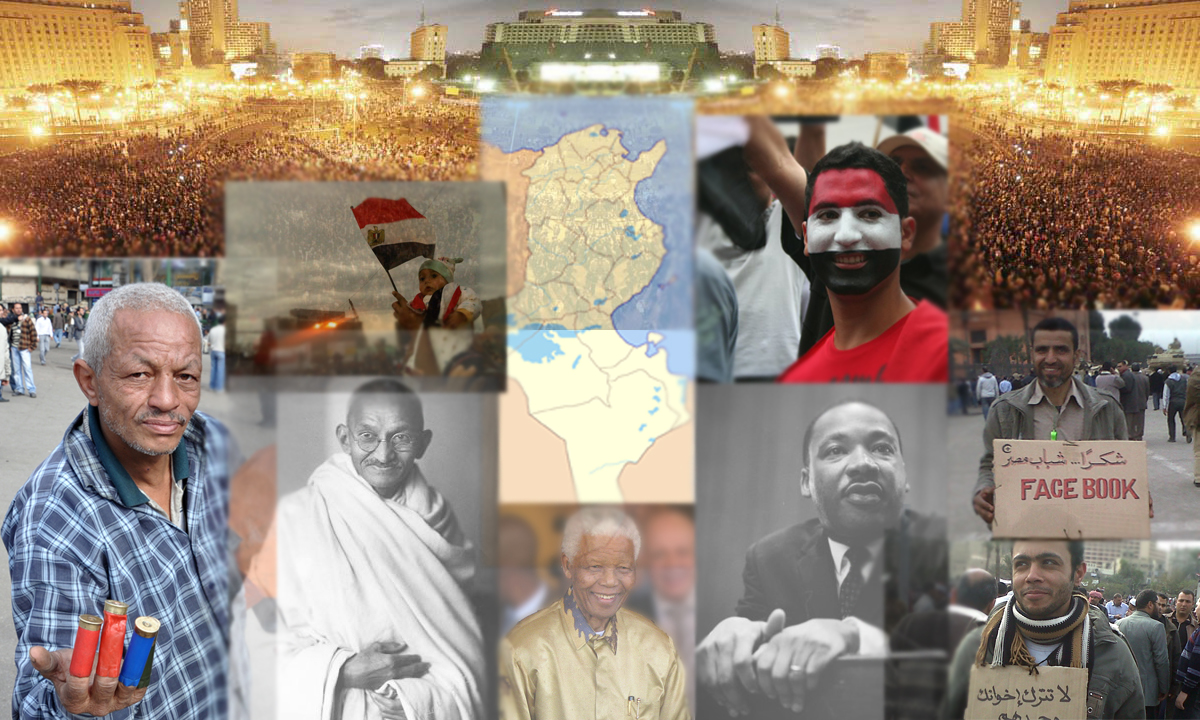
All images are from a creative commons license. The creators of the images are listed below, moving from left to right.
Tahrir square (used twice, flipped horizontally): Flickr user " Flickr Frame Maker "
12 Gauge shells: Flickr user " Floris Van Cauwelaert "
Baby with Flag: Flickr user " Mikeporterinmd "
Ghandi: Flickr user " Adria.richards "
Tunisia Map: Wikimedia commons. Author: Jheald who cites his sources as “Based on Image:Governorates of Tunisia blank.svg by User:Jarke, with rivers from Image:Tunisia_location_map.svg by Hubert Śmietanka, both GFDL/CC-by-SA, and neighbouring borders traced fromImage:Tunisia map-EN.png (CIA World Factbook)”
Mandela: Wikimedia commons. Source attribution: South Africa The Good News, found at www.sagoodnews.co.za
Flag facepaint: Flickr user " Takver "
Martin Luther King Jr.: Flickr user " Mike Licht " who attributes the photo to the Library of Congress.
Facebook sign: Flickr user " Monasosh "
Arabic sign: Flickr user " Monasosh "
A collage of images either from Cairo or echoing the spirit of Tahrir square.