The Persian Gulf, Egypt and Yemen specifically, have suffered major government protests in the recent weeks. These protests come after a wave of democratic, regime change fervor swept over Tunisia. Many in Egypt are disenchanted with the Mubarek presidency and are exercising their freedom of expression in response. While there have not been any significant breakthroughs, the situation is slowly building to a point of unimaginable tension. The people of Egypt want their voices to be heard, and they are doing all they can to ensure that they are a catalyst of change.
Other countries with geographic proximity to Egypt have followed Egypt's lead. Countries like Yemen are now protesting as well. Yemen's president Saleh has been in power for over thirty years. In 2005, Saleh agreed to step aside and allow others to run for election. He has, however, reneged several times on that promise- and the Yemeni people are tiring of their duplicitous leader. Yemen is brimming with political corruption, social upheaval, economic stagnation and terrorism organizations. It will only take one seemingly minor spark to ignite an enormous fire of destruction.
While Saleh has promised not to run for reelection after 2013, Mubarek has not made such concessions. It is not surprising, therefore, that the protests continue to rage on. The issue of national security hangs in the balance. It will be interesting to follow the story as it plays out and carefully examine what policy the Obama administration explores.
As a political science major, these types of revolutionary changes in distant lands fascinate me. That is why the topic of my blog deals with the security of the United States. What happens in countries such as Tunisia, Yemen and Egypt can and will effect either the safety of Americans within the United States or the safety of our citizens abroad. Anderson Cooper serves as one of the most publicized reminders of the pain that mob mentality can inflict. He inserted himself into the protests in Egypt amongst the pro-Mubarek faction. The crowd turned violent and members surrounded Cooper in an attempt to punch, kick and intimidate his efforts. While he successfully escaped, other Americans or people working for America have not been so lucky. There have been reports of stabbings, brutal killings and more tragedies.
Additionally, one has to keep in mind that countries such as Yemen are already failling stats in their own right. The political, social and economic state of Yemen is in such dire straits that Yemen is teaming with Al-Qaeda in the Arabian Peninsula terrorist organization. Any type of a government showdown would only make Al-Qaeda's efforts easier and less restricted in the country. This type of terrorist proliferation would prove a serious and imminent threat to United States' safety.
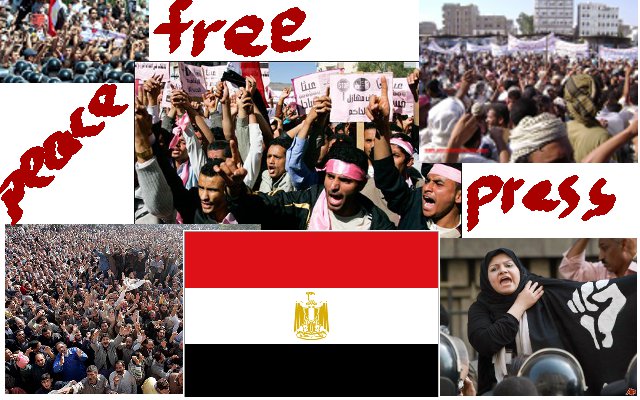
http://www.flags.net/EGYP.htm Egyptian Flag picture, flag drawings by Graham Bartram.
http://www.columnpk.com/tag/egypt-protest/ Million March Announced In Egypt, Posted by Luqman.
http://markskull.blogspot.com/2011/01/egypt-protest-today.html, Posted by Larry West
http://www.lipmantimes.com/?p=19694 photo of woman in Egypt protests taken by Matt Murray
http://www.minnpost.com/worldcsm/2011/01/28/25302/are_yemens_protests_go... photo of protest in Yemen, photo taken by Khaled Abdullah
http://mypetjawa.mu.nu/archives/190276.php photo of Yemen protest, found on the Jawa Report website.
This is a snapshot of what has transpired over the past few weeks in the Persian Gulf region. Protests that began in Tunisia have rocked the region as a whole. The political fervor has spread from Tunisia to countries like Yemen and Egypt. It has gripped the people and has instilled a sense of unknown in a perilous region of the world.